

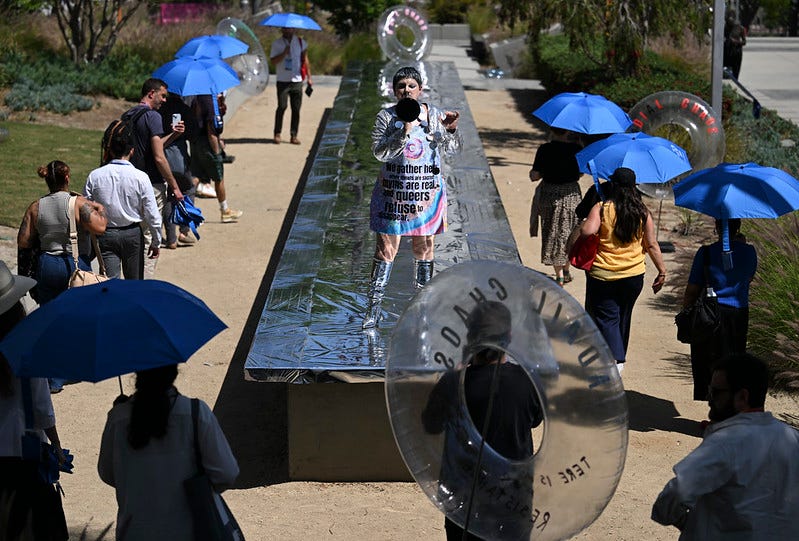
The last two editions of the GCDN annual convening have featured place-based performances that were especially commissioned for the occasion. Prior to that, while artistic experiences were always present they were usually on the sidelines, more ornament than substance.
Meanwhile, the feedback from attendees and indeed our own internal reflections called for more artist voices in the mix – and, rather uncreatively, we thought remedying that meant making sure that we included them in our intellectual content.
So we held sessions about the value of art in the public space. We underlined its potential to craft successful narratives of place; to beautify by the complex simplicity of its existence; to fuel a creative economy and a thriving nightlife; to make magnetic and profitable destinations; to connect communities and bridge divides through shared experiences and emotions. Practice, for us, meant workshopping how to activate cultural districts through public art. We explored how to measure and report the impact of these activations so their value would be legible to all stakeholders. We discussed strategies to blunt the dreaded side effects of that recognition – gentrification and displacement… Oh, we certainly talked about art. In depth. At length. And we dutifully made space for artists on panels and in sessions. But in doing all that, we forgot a cardinal rule of artistic expression: show, don’t tell.
Then two years ago, Bella Stenvall, a former research analyst at AEA Consulting who is herself a dancer, joined one of the early internal planning sessions for Athens 2024 to help us imagine new formats and make our program more dynamic.
We had just delivered Montreal 2023 with the Quartier des spectacles. Amid a flurry of praise, two critiques kept surfacing: we had kept people indoors too long, and – despite our host’s best efforts to showcase homegrown talent – we had once again failed to stitch our high-level global conversations into the fabric of the local ecosystem. Message (finally) received. Panel sessions about murals and PowerPoint slides about public art were not cutting it. We had to do better. Athens gave us that chance.
A New Opportunity in Ancient Athens
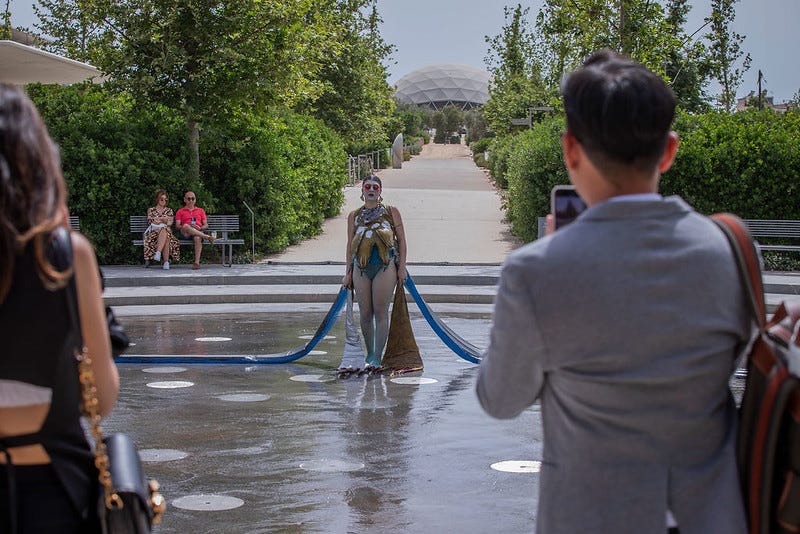
The Stavros Niarchos Foundation Cultural Centre (SNFCC) is a magnificently run multi-venue campus with a generous park at its heart. Open to the public but under the curatorial custody of the SNFCC, it offered us something Montreal never could: predictable May weather. Sunny with a dash of sunny. From the outset, outside programming was not just possible but obvious. More importantly, the park gave us license to rethink format.
That’s how we ended up turning to younger AEA staff for ideas. The hope was that, with fewer conferences under their belts, their imaginations would be unclouded by the insidious notion that the only format that matters is the almighty panel.
The gamble paid off. Athens 2024 was widely praised as our best edition yet, with the variety of formats and dynamism of the program singled out across the board. One experiment in particular stood out: the Walkshop.
Initially put forward by Bella and later shaped with Alyssa Cartwright – herself a visual artist – the idea was fairly straightforward. GCDN commissioned three short outdoor performances to be presented in the SNFCC park as part of the convening program. Each would run about ten minutes and, beyond artistic quality, had to be rooted in the site. Whether a dancer activating a water fountain or a DJ scoring a section of the park with birdsong, the pieces asked what it meant for art to inhabit public space and invited reflection on questions ranging from the prosaic logistics of production to broader social and existential issues.


Participants followed the circuit and watched each performance in turn before convening for a moderated conversation with the artists – a space to think together about how cultural districts can better support their creative communities and amplify local voices in global debates.
And with that, we cracked it. Art was finally part of the meal, not just table decoration. Turns out we had to show, not just tell. Hardly a novel concept, but new to us – and it worked well.
By staging performances in public space, the Walkshop not only tied the convening to its setting and opened it up to passersby as well as attendees; it also reminded our guests that, beyond their positions and responsibilities as senior cultural and urban leaders, they were still, first and foremost, human beings. Through the experience of art they, like anyone else, could be moved, inspired, amused, shocked, awed… in essence, they could be made to feel – and that those feelings, particularly when they are shared with others, are the true lifeblood of a cultural district.
Admittedly, the process of developing this format was first and foremost a response to feedback. Our job at GCDN is, above all, to serve our members and make the convening experience as meaningful as possible. But the act of commissioning public art offered us something more. It gave us a way to confront the realities of each place head-on, through the eyes of its artists. Just as our audience did.
Planning a GCDN convening takes around nine months. Each year, because it happens in a new city, much of that time is spent absorbing the local context so the program can properly reflect it. That roving character is the added value of our model – the benefit that outweighs the logistical challenge and makes it worthwhile for both the team and our members. Yet, that learning remained mostly theoretical when only applied to framing session angles or selecting local voices for panels. The Walkshop gave that knowledge a new dimension, surfacing – in raw, unmoderated form – the topics that were alive in the places we visited.
This was already in evidence in Athens, where Konstantinos Papanikolaou’s choreography emphasised the organic nature of performing in public space, Chara Stergiou’s bird song soundtrack invited us to reflect on the biodiversity of places where humans and nature coexist, and Iria Vrettou’s mesmerizing activation of a water fountain explored themes of female empowerment and sexual liberation – to the amused and bemused looks of passing families with strollers and toddlers in tow.
But it became even clearer in Los Angeles, where we presented a program of performances titled Queer Anthropologies.
Los Angeles: Diegetic Doughnuts and Generative Meaning-Making
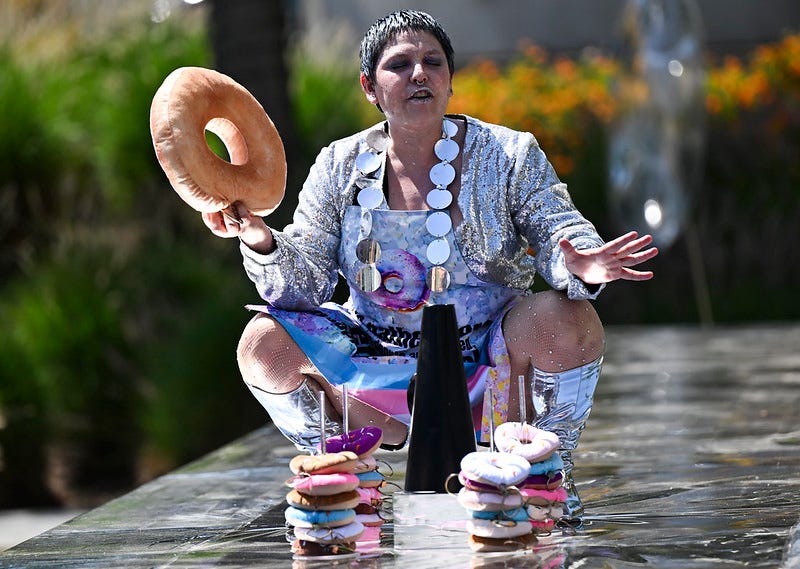
Curated by Robin Abad Ocubillo and Eric Solis, Queer Anthropologies took shape across Gloria Molina Grand Park through three site-specific works. At the Memorial Fountain, Star Feliz (performing as Priestussy) invoked ancestral waters with a trance-like ceremony that blurred myth, grief, and joy into an oracular act of renewal. At the Community Table, Carmina Escobar guided participants through a mirrored ritual of breath, gaze, and taste that echoed histories of defiance and belonging in Los Angeles’ queer lineage – all the while feeding us doughnuts that were not only delicious but also diegetic. And at the Pavilion, Tyler Matthew Oyer resurrected the memory of Beverly Shaw, a mid-century cabaret singer and lesbian club owner, weaving performance and homage into a reminder of lives lived against erasure.
The post-performance discussions turned the park into a platform for dialogue as much as expression. Artists and participants reflected on the nature of queer space – safety, freedom, fluidity, opposition to capitalistic forces, inclusiveness – and on the social and political potential of ephemeral performance. Themes of trust, authenticity, and community-led curation came to the fore, alongside calls for institutions to provide time, resources, and alignment when supporting site-specific work.
The conversation showed that queer narratives not only reclaim marginalized histories but also reshape public space into something more inclusive, dynamic, and alive. Yet inclusiveness is never uncontested, as demonstrated when one of these discussions was interrupted by homophobic heckling from a visibly distressed individual, addressed swiftly and with care by park security. Whilst distressing and uncomfortable, the intrusion laid bare the paradox of public space and the complexity, perhaps even the impossibility, of curating a space that is truly of and for all.
That reminder only deepened the sense of fragility and underscored the urgency of the issues being surfaced, leaving the exchange more charged, and more real, than anyone had anticipated. Then, only two weeks later, the cheerfully pink, RIOS-designed chairs around which Tyler danced and on which we sat during the discussion part of the Walkshop were pictured in the news, repurposed as props in anti-ICE protests – a visual echo as visceral as the performances themselves and a sobering reminder of the many layers of meaning that otherness carries, and of how public space becomes the stage on which those meanings are contested.
In a year of political retrenchment, when authoritarian turns threaten hard-won progress on LGBTQ+ rights across the Western hemisphere and in the United States in particular, these performances and conversations felt urgent, vital, and cathartic. This was not really our intention when we began working with Robin and Eric to develop Queer Anthropologies in the summer of 2024, when the world looked surprisingly different. But by the time we arrived in Los Angeles in May 2025, our commitment to delivering that section of the program had become a response to a new reality, and we felt both humbled and privileged to be in a position to hold that space.
But producing sessions is not the same as commissioning public art. Los Angeles was only our second convening to feature the Walkshop format, and the logistical hiccups we encountered along the way were reminders that we are still learning. We need to hone our approach and, in keeping with the principle of ‘show don’t tell’, the best path forward is to ‘KISS’ the format. So we will try to not be stupid and keep it simple – at least as far as our involvement is concerned.
Having local curators who understood the landscape far better than we could was an improvement from Athens to LA. So was having a clear curatorial statement as an extra layer of connective tissue to ground the pieces. The theme itself is also a crucial choice. We don’t imagine the Walkshop should always serve to deliver political messages, but as a mirror of civic life, public art is never apolitical. Our commissioning choices carry that responsibility.


Moving Forward
As individuals on the GCDN team, we deeply believe in the values reflected in the works we supported in Athens and LA. But we are also conscious of the global nature of our network, and of the fact that delivering a convening that feels truly anchored to its place means being culturally aware and sensitive. GCDN is not a lobbying group or an activist organisation. It is a platform for knowledge exchange among international peers, whose diversity is a strength to be understood, respected, and celebrated. And that understanding, that respect, is key.
Whether the Walkshop becomes an annual fixture is still to be defined. Contextual realities might not always allow, and perhaps even not always call for it. What does seem clear, though, is that the best way forward is to entrust the Walkshop to a local curator, selected in collaboration with our hosts. The former ensures a robust curatorial statement that aligns with the overall narrative of the convening, as well as someone with the bandwidth and know-how to navigate the complexities of producing and delivering public art in that specific context – both things we perhaps lacked a little in Athens. The latter helps with logistics and ensures that communication flows from the start – a lesson from Los Angeles. As long as everyone aligns on a common objective for the format from the outset, this approach should allow the segment to develop more autonomously and with fewer hurdles, while ensuring that what we deliver showcases the local public art scene with sensitivity and care.
We’ve put a lot of thought into this – and we’ll keep doing so. Thinking is what we do. But ultimately, our goal is to keep finding ways for artist voices to be heard in the GCDN convening program in the best way possible: by letting them show, rather than only tell.