

How a Silent-Film Classic Became a Journey Through Cultural Landscapes, Digital Technologies and Learning
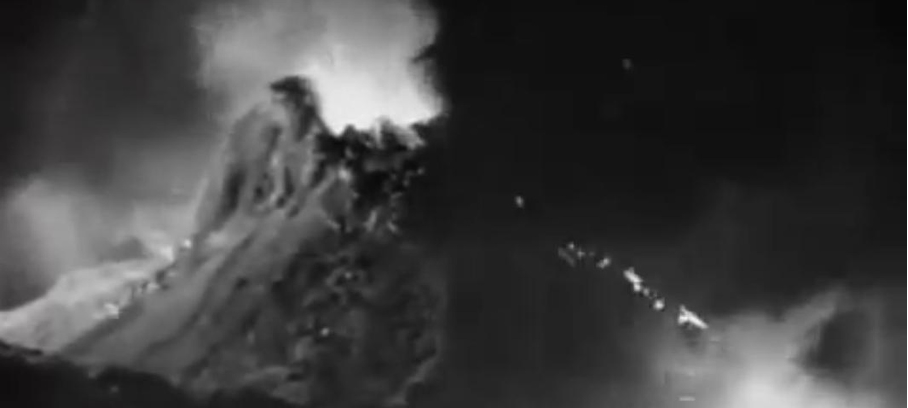
From Cabiria to SPARK
What happens when a film made more than a century ago becomes a way of reading contemporary places? The SPARK project stems from this question. The project was developed within CHANGES – Cultural Heritage Active Innovation for Sustainable Society, the Extended Partnership funded under Italy’s National Recovery and Resilience Plan (PNRR) and dedicated to cultural heritage and the humanities. Bringing together universities, research institutions, enterprises and third-sector organisations, CHANGES creates a national ecosystem in which research, education and technological innovation meet around the understanding, preservation and accessibility of tangible and intangible heritage.
SPARK sits within Spoke 2 – Creativity and Intangible Cultural Heritage, coordinated by the University of Milan. Here, creativity is not treated as something separate from heritage, but as one of the ways in which heritage continues to circulate: through stories, images, practices, performances and collective memory. Technology enters this landscape not as an end in itself, but as a means of reconnecting places, cultural narratives and the people who experience them.
The project emerged from a cascade funding call launched by the University of Milan to extend participation beyond the original CHANGES consortium. Jointly proposed by EHT S.C.p.A. and the University of Rome Tor Vergata, SPARK was selected within the area devoted to advanced digital technologies and intelligent applications for the performing arts and audiovisual media.
The partnership brought together complementary expertise. At the University of Rome Tor Vergata, the Department of History, Cultural Heritage, Education and Society, under the scientific coordination of Professor Antonella Poce, shaped the scientific, educational and methodological framework: selecting and interpreting the heritage connected with Cabiria (1914, first colossal movie in the History of Italian Cinema), designing Digital Storytelling and Object-Based Learning activities, developing pathways for schools and coordinating the pilot studies. EHT S.C.p.A. developed the digital platform and interactive technological components. The result is a project in which educational research, cultural heritage and digital innovation are designed to work together from the outset.
A Film as a Map
The storytelling engine of SPARK is Cabiria, Giovanni Pastrone’s 1914 silent-film landmark. Its story moves through an imagined ancient Mediterranean populated by volcanoes, temples, journeys and memorable figures such as the mythical character of Maciste. For SPARK, that cinematic geography became a point of departure: a way to connect Mount Etna and Carthage, the Temple of Moloch and the streets of two contemporary Italian territories, Giarre in Sicily and Testaccio in Rome.
Rather than turning the film into a static object of study, SPARK uses it as a narrative thread. Digital Storytelling connects places and historical content through stories; Object-Based Learning asks participants to look closely, compare, question and interpret cultural objects. A virtual exhibition, geolocated itineraries, Virtual Reality, 3D models and mobile technologies extend that process across physical and digital space. The aim is not simply to deliver more information, but to make heritage something to investigate.
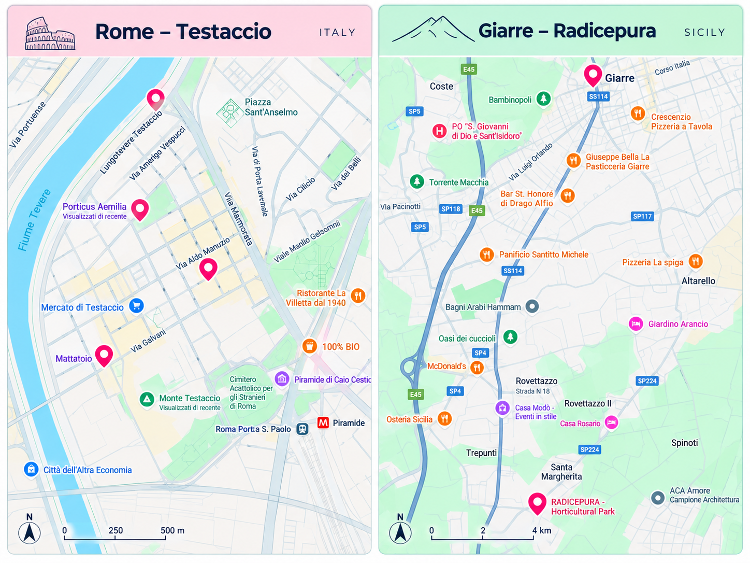
The journey begins in Giarre, within the Etna Volcano Park in Sicily, and continues in Rome’s Testaccio district. In both places, streets, landscapes, archaeological remains, museum collections and cultural sites become parts of a shared narrative environment, connected through digital maps, immersive experiences and three-dimensional objects.
Moving between the territory and its digital counterparts, participants encounter the same heritage from different angles. A place visited on foot can reappear as a virtual reconstruction; a cinematic image can become the starting point for reading an archaeological site; a digitised object can be grasped and examined through haptic interaction. Technology does not replace the encounter with place. It helps reveal details, create connections across time and space, and turn a visit into an active process of discovery.
Two Experiences, One Journey
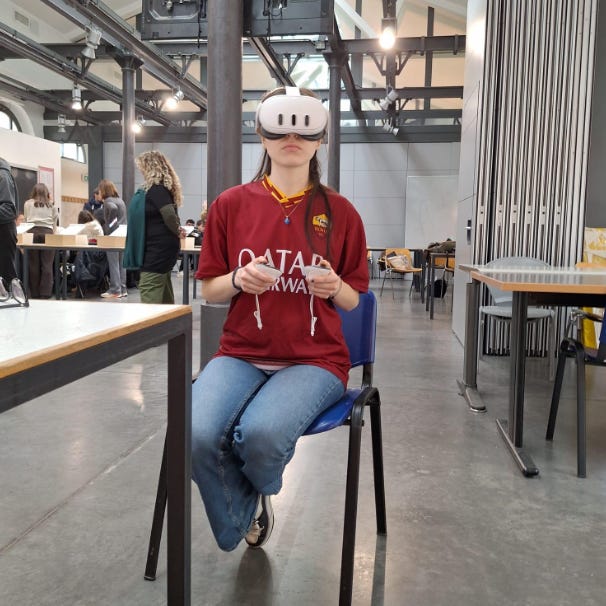
SPARK unfolds through two connected digital experiences. Master of Deep Fire is an immersive virtual exhibition organised around themes including sacrifice, religion, cinematic innovation, symbolism and the major characters of Cabiria. Visitors move freely through multimedia galleries combining images, sounds, interactive narratives and 3D artefacts.


The Roar That Awakens the Sleepers takes the story outside. This geolocated mobile itinerary draws on Mount Etna, Giarre and the symbolic landscapes evoked by the film. As users move through the territory, the web application introduces historical information, multimedia material and narrative elements linked to their location.
The two experiences are deliberately interconnected. A detail encountered in the landscape can be revisited in the virtual exhibition; a discovery made in VR can acquire new meaning when it is recognised in a real place. Among the digital artefacts is a three-dimensional reconstruction inspired by Moloch, one of Cabiria’s most recognisable images. Rotating and examining the model alongside the film’s visual language opens a space for questions about how cinema has imagined, stylised and transmitted antiquity.


Behind the Experience
The technology behind SPARK was built to support this movement between seeing, moving and interpreting. The immersive environment was developed in Unity for Meta Quest 3 headsets, allowing participants to navigate virtual spaces and interact directly with digital heritage objects.
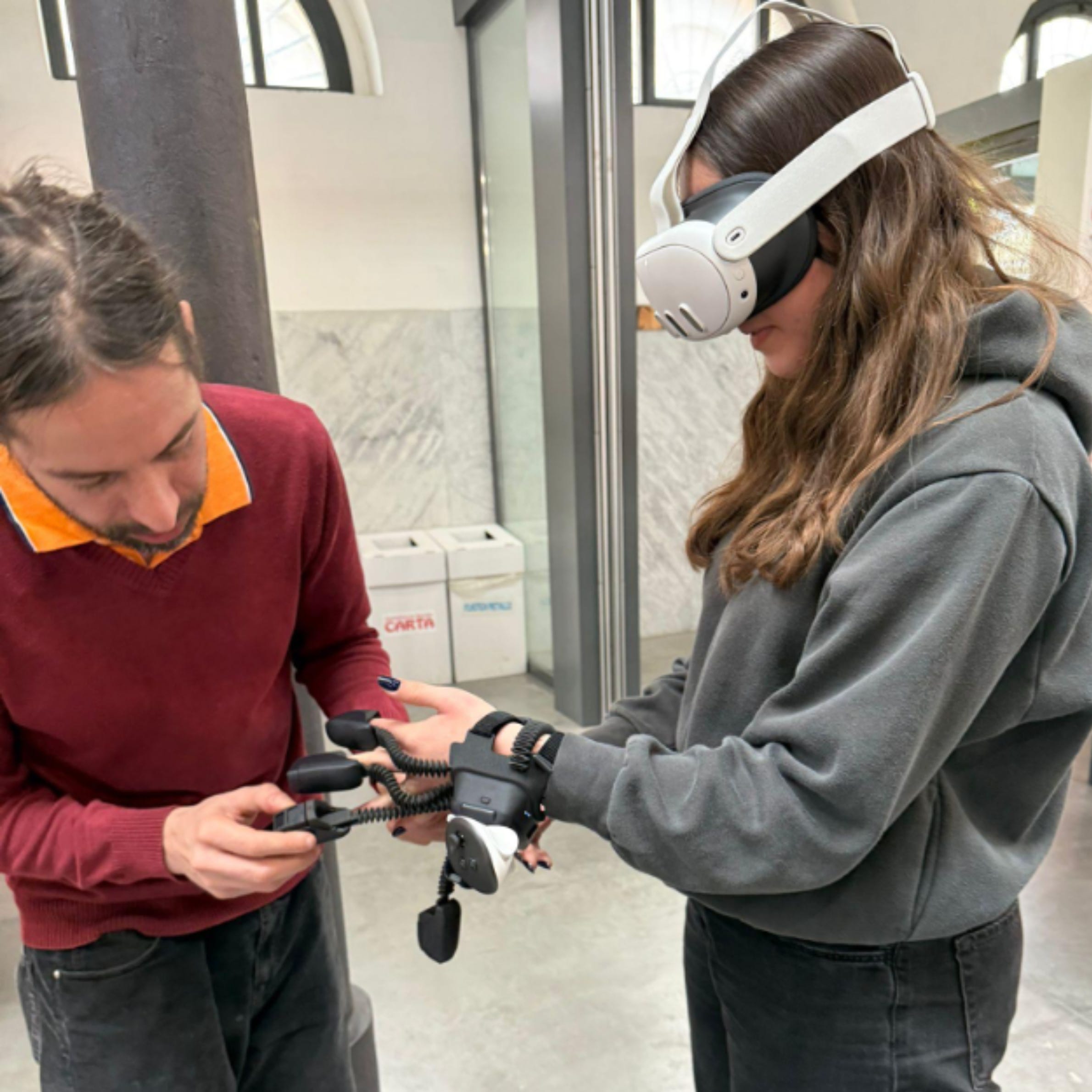
Haptic interaction adds another layer. Using the WEART TouchDIVER Pro glove, participants can grasp, rotate and examine three-dimensional artefacts, bringing a tactile dimension to an otherwise visual encounter. The gesture is simple, but educationally significant: the object becomes something to explore rather than merely look at.
The physical sites required a different kind of translation. Aerial surveys with a DJI Matrice 400 drone produced high-resolution photographic datasets of selected cultural and archaeological environments. These images were then processed in Agisoft Metashape to reconstruct three-dimensional meshes through photogrammetry.
The resulting models form the basis for SPARK’s digital representations of the documented sites. Some planned digital twins have already been partially reconstructed, while modelling, refinement and integration continue. Their unfinished quality is part of the process: rather than fixed replicas, they are evolving representations that can grow as new documentation and data become available.
This technical work remained closely tied to the project’s educational design. EHT S.C.p.A. developed the platform and technological components, while the University of Rome Tor Vergata provided the scientific, pedagogical and methodological framework. The guiding principle was straightforward: innovation should earn its place by enriching interpretation, participation and learning.
Giarre: Learning Through the City
The first pilot took place in Giarre, where around 100 students from Leonardo Secondary School and their families moved between a geolocated urban itinerary and an immersive virtual experience. The route turned the city itself into a learning environment. From the Belvedere of Santa Maria la Strada, Mount Etna framed reflections on landscape; Via Callipoli and the historic centre opened onto architecture and local traditions; Villa Margherita and Radicepura introduced questions of biodiversity, migration and environmental sustainability.
Participants were invited to do more than follow a route. They observed, interpreted and connected what they saw with the narrative world of Cabiria. The digital map therefore worked less as a navigation tool than as a prompt for inquiry. Back at school, the virtual museum allowed the same themes to be revisited through immersive environments and interactive artefacts, linking direct experience, historical interpretation and cinematic memory.


Testaccio: A Different Landscape, the Same Story
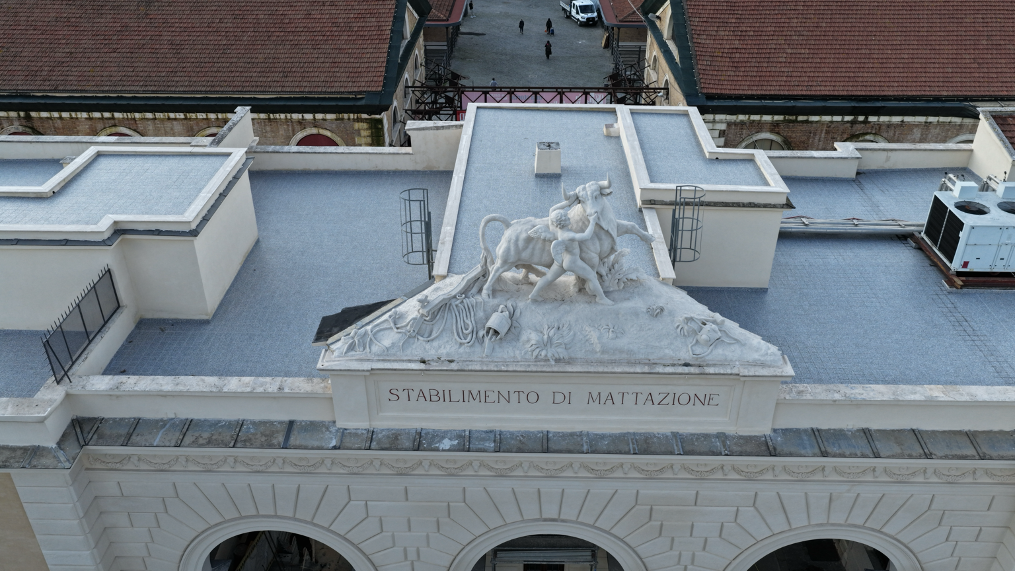
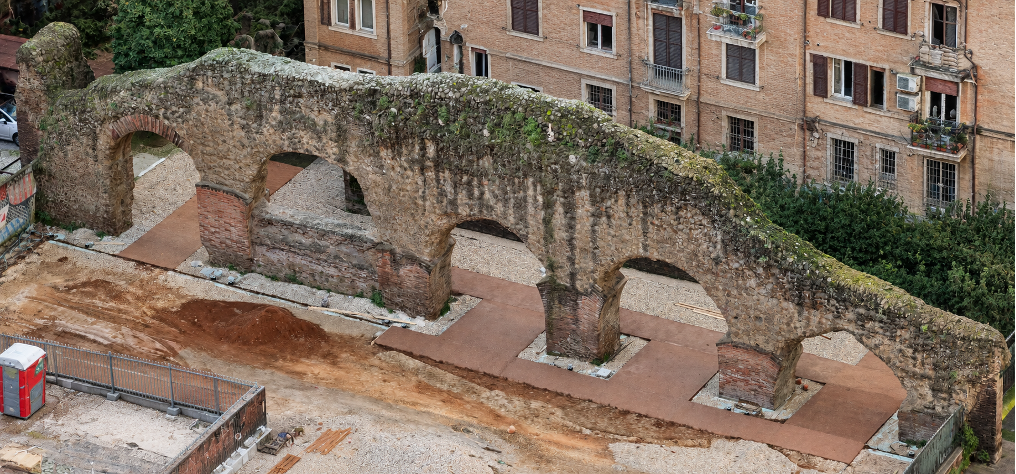
The second pilot moved to Testaccio, one of Rome’s most historically layered districts, within a school-based dual learning programme. Here too, students combined a geolocated itinerary with the virtual museum. But the urban material changed: the ancient Emporium and Porticus Aemilia recall Rome’s commercial history; Monte Testaccio preserves the material traces of centuries of trade; and the former slaughterhouse, the Mattatoio, speaks to the district’s industrial past.
Maps: Testaccio | Porticus Aemilia | Emporium | Monte Testaccio | Mattatoio
Through the web application, these different layers were connected by narratives inspired by Cabiria. Travel, exchange, encounters between cultures and urban transformation became ways of reading the district. After the field visit, the virtual museum offered a second encounter with the same questions, helping participants reorganise observations and see how a place can be understood through multiple sources, media and perspectives.
When Digital Heritage Can Be Touched
In both pilots, the WEART TouchDIVER Pro glove shifted the relationship with the digital object. Participants could grasp, rotate and inspect three-dimensional artefacts while discussing what they might have meant, how they may have been used and what evidence supported each interpretation. Haptic technology was not presented as a substitute for authentic objects. Its value lay in adding another sensory route into observation, curiosity and collaborative discussion. The digital replica became a thinking tool.
Building Digital Twins in the Field
Testaccio also became a site of digital documentation. Drone surveys recorded the former slaughterhouse, the Porticus Aemilia, the Emporium and Monte Testaccio. Using a DJI Matrice 400, the team collected high-resolution aerial imagery, later processed in Agisoft Metashape to generate three-dimensional meshes of selected environments.
These models are the starting point for SPARK’s evolving digital twins: navigable and updateable three-dimensional representations that can support research, education, remote access and long-term documentation. Some environments have been partially reconstructed; others remain under development. This also allowed participants to see that a digital twin does not emerge at the click of a button. It is built through a chain of historical research, field survey, documentation, modelling and technological refinement.
What SPARK Suggests for Cultural Districts
Giarre and Testaccio offered two very different settings for the same experiment. In Sicily, the journey was shaped by volcanic landscapes, local identity and environmental heritage. In Rome, it moved through archaeology, commerce and the long transformation of an urban district. Cabiria provided a common narrative thread, but each territory produced its own reading.
Across both experiences, one lesson remained consistent: cultural heritage becomes richer when people can approach it through more than one route. Walking through a city, entering a virtual museum, handling a digital artefact or observing the making of a digital twin are not competing experiences. Together, they can create a layered form of participation in which cultural institutions, schools, universities, technology partners and local communities all contribute to interpretation.
SPARK’s most useful proposition may therefore be a simple one. Digital technologies matter not because they make heritage less physical, but because they can encourage us to look again: more closely, from another angle, and with better questions. Through Cabiria, a film from 1914 becomes a bridge between cultural landscapes and contemporary learners — and the past becomes something to enter, discuss and rediscover.
ABOUT THE AUTHOR
Antonella Poce is Full Professor of Experimental Pedagogy at the Department of History, Cultural Heritage, Education and Society at the University of Rome Tor Vergata. She is the founder and Director of the INTELLECT – International Research Centre for Heritage and Museum Education, Well-being and Teaching Technology, where she coordinates interdisciplinary research activities and postgraduate programmes devoted to museum and heritage education. Her research focuses on experimental research methodologies in education, museum and heritage education, Object-Based Learning (OBL), critical thinking development and assessment, and the design and evaluation of technology-enhanced learning environments. A significant part of her recent work explores the educational potential of digital and immersive technologies, including virtual and augmented reality, digital storytelling and artificial intelligence, with particular attention to accessibility, inclusion, participation and well-being in cultural heritage contexts. She has coordinated and participated in several national and international research projects and is currently involved in research and innovation activities as international relations expert within CHANGES – Cultural Heritage Active Innovation for Next-Gen Sustainable Society, the Extended Partnership funded under the Italian National Recovery and Resilience Plan (PNRR). Her work within this framework investigates innovative approaches to cultural heritage interpretation, audience engagement and the development of technology-supported, participatory and sustainable heritage experiences.
ABOUT GCDN BRIEFS
GCDN Briefs is a series of articles highlighting insights from members of the Global Cultural Districts Network (GCDN) and associated experts on themes and issues that are relevant to the day-to-day lives of cultural districts. Intended to present the state of play and propose actionable recommendations, these articles complement the annual GCDN research projects and enhance the dissemination of ideas and best practices within the network and beyond.